Update, 24 November 2026. We published this post after the sell-off, but hours before Nvidia's board reinstated Jensen Huang as chief executive and the market rallied hard. Nvidia's 8-K filed with the SEC on 23 November says the board reinstated him as President, Chief Executive Officer and director on 22 November, effective immediately, and that Colette Kress continues as CFO. Our assessment does not change. With or without Huang, Nvidia's filings show no evidence of manipulation, its 10-Q has still not been filed and remains the document that settles the open questions, and at the prices used here we still think Nvidia is undervalued. The same holds for AMD: its books pass, and we think its price already pays for its position.
AMD short report and Nvidia SEC probe: the short version
Disclosure first: the author has owned AMD and Nvidia shares since April 2025, and so have his family and his company; his tax-advantaged accounts hold both too. His company also holds long-dated call options (LEAPS) on both, bought before the short report, because our internal risk limits allowed no more equity at the time. Any of these accounts may buy or sell either stock, in shares or options, at any time within those limits. This post examines a short report on a stock we own. Read it with that in mind, and judge whether we tested the position or defended it.
Two stories hit the two biggest AI chip makers in the same week. On 19 November the short seller Hunterbrook published a report on AMD and disclosed a short position. The next day Reuters reported, citing people briefed on the matter, that the SEC's investigation of Nvidia has a focus on its accounting. The Wall Street Journal had first reported the investigation on 17 November. An SEC investigation is not evidence of wrongdoing: its specifics are not public, and it can end without any charges.
What the filings show, in brief:
- The AMD short report is not an accounting allegation. It is about export controls: whether a blacklisted Chinese server maker kept receiving AMD firmware. Hunterbrook itself stops short of proving it. In its own words: "Hunterbrook does not know how IEIT obtained AMD's code, or whether AMD or anyone else held a license to supply it." No financial statement can prove or disprove it.
- AMD's accounts pass the usual tests for stuffing the channel, with one soft spot. Receivables grew in line with revenue over the year. Inventory grew faster, and the quarter's operating cash flow leaned on paying suppliers later, which AMD attributes to timing.
- Nvidia's 10-Q has not landed. All we have is an unaudited earnings release and a supplemental document. The numbers in it are extraordinary, but its accruals have widened, and receivables grew faster than revenue because of what Nvidia calls extended payment terms.
- On price, we think Nvidia is undervalued and AMD overvalued. Nvidia trades at about 20 times its free cash flow, AMD at about 99 times. AMD's premium is the price of being the only proven alternative to Nvidia, and we think the price already pays for it.
- On the balance of probabilities, we see no evidence of accounting manipulation at either company in what has been filed so far. That view can change, and we list exactly what would change it.
This is analysis, not a recommendation to buy or sell. Prices used: AMD $424.39, its close on 20 November 2026, and Nvidia $125.
The claims, tested against the filings
Each claim in this story, who made it, how we tested it and what we found. A verdict is one of five labels: Confirmed, Mislabelled, Not supported, Unproven or Open.
| Claim | Made by | How we tested it | Verdict |
|---|---|---|---|
| AMD bills 22.4% of its revenue to China and Hong Kong | Hunterbrook | Beat Index: Revenue & Income, revenue by geography, from AMD's 2025 10-K | Confirmed. $7.75B of $34.64B. Billing location is not always where a chip ends up |
| AMD has promised about $33B of support to customers and partners | Hunterbrook | Beat Index: OBS Signals, for the guarantees. Filing text: commitments note of AMD's September 10-Q, for the leases, cloud capacity and equity investments | Confirmed. Guarantees $8.5B, data-centre leases for partners $13.3B and cloud capacity $6.2B make $28.0B, plus up to $5.1B of equity investments. These are maximums, and much of it is owed only if a partner defaults or capacity goes unsold |
| AMD's purchase commitments quadrupled in nine months | Hunterbrook | Beat Index: OBS Signals, purchase obligations by quarter | Confirmed. $12.2B at the end of 2025, $48.8B in September, mostly wafers, memory and packaging |
| AMD is stuffing the channel | Implied by the sell-off | Beat Index: Cash Flow, and Asset Composition under Liquidity & Leverage, receivables, inventory and cash flow against revenue (section 2) | Not supported. Receivables grew 49% against revenue's 45%. Inventory, up 57%, is the one soft spot |
| AMD breached US export controls | Hunterbrook | Not testable from financial statements | Unproven. Hunterbrook's own words stop short of it, and no Commerce Department finding has been reported |
| The SEC is investigating Nvidia's accounting | Reuters, citing sources | Filing text: Nvidia's 8-K and earnings release, which do not mention it | Unproven. Neither has confirmed it, and an investigation is not evidence of wrongdoing |
| Nvidia's accounts are manipulated | Implied by the probe headlines | Beat Index: Custom Plot, Beneish M-Score rebuilt from the filings, plus our own rerun with sales growth held neutral (section 4) | Unproven. The score is flagged, driven by accruals from longer payment terms and investment gains, which it cannot tell apart from manipulation |
| Nvidia's third-quarter numbers are final | Nvidia's unaudited release | Filing text: SEC EDGAR, searched for Nvidia's 10-Q | Open. No 10-Q as of 22 November; it is due about 4 December |
How we check
Every figure in this ledger comes from the companies' own filings with the SEC, not from a data vendor. Each test says where its evidence sits. Beat Index means the value is one our own pipeline reads from EDGAR and holds, and the named tab shows it: you can open AMD or Nvidia there and see the same number. Filing text means we read it directly from the filing because our data does not yet carry it. Not testable means the filings cannot reach the claim at all. Where a company has revised an earlier figure, we use the revised one. Forensic scores are rebuilt factor by factor from the filed numbers, so we can see what drives a flag instead of only reporting it. A claim the filings cannot test is labelled Unproven, not dismissed, and a verdict that waits on a filing is labelled Open.
1. What Hunterbrook alleges, and what AMD said
Hunterbrook's report says that IEIT Systems, a Chinese server maker added to the US Commerce Department's Entity List in March 2025, has built at least six newer versions of AMD's startup firmware into its own server updates since it was blacklisted. It says three other server makers offer firmware nearly identical to IEIT's. In its own words: "Hunterbrook does not know how IEIT obtained AMD's code, or whether AMD or anyone else held a license to supply it." Of two smaller China relationships the same report covers, it says the "records Hunterbrook found don't establish on their own a violation of export laws."
AMD has published no statement of its own on the report. Hunterbrook records its side in the report itself: "AMD did not answer Hunterbrook's questions. The company asked for more time, was given until the following day, and said it would be back in touch by then. It was not." On licences, it adds: "AMD did not say whether it holds licenses allowing it to sell chips or software to any of the blacklisted companies named here." AMD's standing position is on its trade compliance page: "AMD is committed to fully comply with all applicable United States export and import laws and regulations governing the export, re-export, or import of AMD products, software, services and technology." No Commerce Department finding against AMD has been reported.
Hunterbrook's report, and its companion analysis The Bank of AMD, also make financial claims. We took each one in Hunterbrook's own words and checked it against AMD's filings:
| Hunterbrook says | What AMD's filings show | Our assessment |
|---|---|---|
| "AMD billed $7.75 billion, or 22.4% of revenue, to China (and Hong Kong) in fiscal 2025" | $7.75B of $34.64B in the 2025 10-K | Right. It is by billing location, so it measures where invoices go, not where chips end up |
| "It has also committed about $28 billion through guarantees, partner leases and cloud-capacity agreements, plus $5.1 billion in equity investments" | September 10-Q: guarantees $8.5B, data-centre leases to be passed to partners $13.3B, cloud compute $6.2B, equity investment commitments up to $5.1B | Right, about $33B in all. These are maximums, not expected costs: the cloud commitments shrink as third parties pay for the capacity, the leases are meant to be assigned or sublet to partners, and the guarantees pay only if a partner defaults |
| "The customer and partner guarantees AMD doubled to $8.5 billion in three months" | $4.1B in the June 10-Q, $8.5B in September | Right. The fastest-growing item, and the one to watch each quarter |
| "Its purchase commitments have quadrupled in nine months, from $12.2 billion at the end of 2025 to $48.8 billion in September" | $12.2B in the 2025 10-K, $48.8B in the September 10-Q, of which $33.4B falls due by the end of 2027 | Right. These are orders for supply, the same bet on demand that shows up as the inventory build in section 2 |
| "AMD has promised customers up to 320 million shares" | Two warrants of up to 160 million shares each at $0.01, vesting as the customers hit purchase milestones and the share price hits targets | Right. If fully exercised, about 16% of the enlarged company, as Hunterbrook says |
| "AMD itself has just $15.8 billion of cash and short-term investments on hand" | $15.8B in the September 10-Q | Right. The $33B of support is about twice that, but it is not owed at once or in full |
Where we part from Hunterbrook is not on the numbers but on what they mean. Every figure it gives matches AMD's filings. Read together, they describe a company using its balance sheet to win AI customers, which raises the risk if demand slows. They do not show that the money is already spent or that any partner has defaulted.
AMD's 10-Q for the quarter to 26 September reports no material legal proceedings.
2. What AMD's filing shows: the working-capital test
When a company inflates sales by pushing product onto customers, three things usually show up together: customers owe more relative to sales, inventory piles up, and profit runs ahead of cash. AMD's latest quarter shows inventory and receivables both rising sharply, which is why the question is fair.
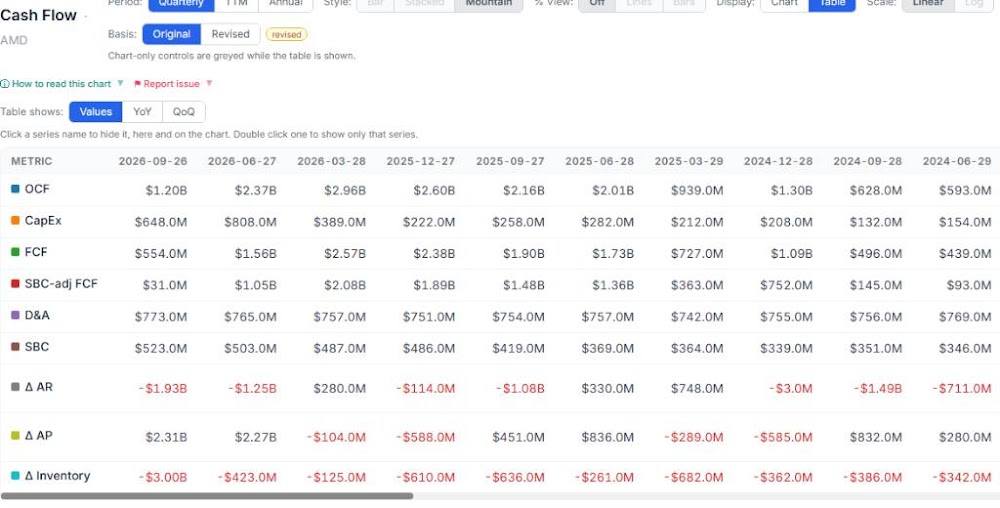
The test is not whether receivables and inventory rose, but whether they rose faster than sales. From AMD's balance sheets:
| AMD, quarter to 26 Sep 2026 | Amount | Versus the June quarter | Versus a year earlier |
|---|---|---|---|
| Revenue | $13.38B | up 16% | up 45% |
| Receivables | $9.21B | up 26% | up 49% |
| Inventory | $11.46B | up 35% | up 57% |
| Payables to suppliers | $7.76B | up 45% | up 123% |
These growth rates come from the balance sheet, not the cash flow table above, and the two measure different things. The balance sheet shows what AMD holds on the last day of the quarter: $11.46B of inventory. The cash flow table shows how much that holding changed during the quarter, counted in cash: $3.00B spent building it. Growth is measured on the holding, so the 57% appears only on the balance sheet.
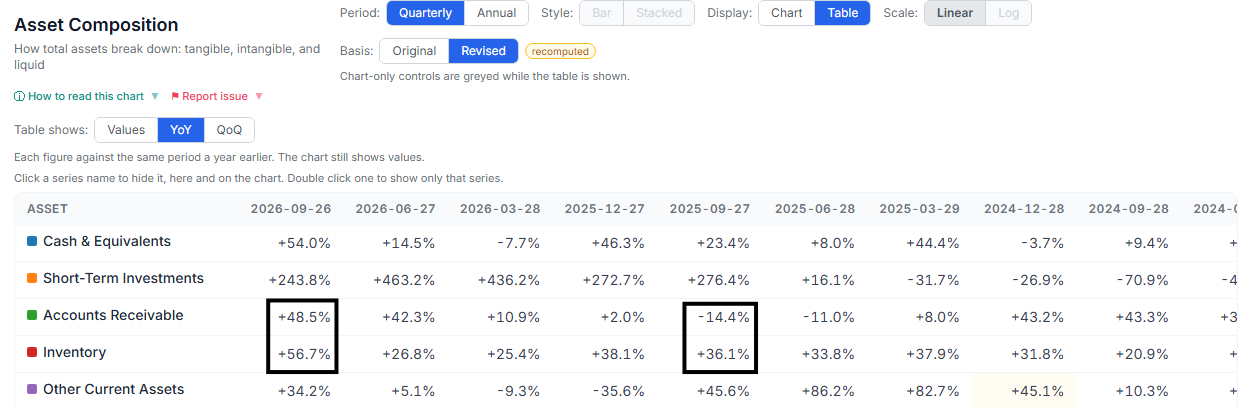
The boxed columns tell the story. A year ago, inventory grew 36% and revenue grew 36%: the build kept pace with sales. This year inventory grew 57% against revenue's 45%, so AMD is holding stock ahead of sales it has not yet made. Receivables, at 49%, still roughly track revenue.
Receivables: no sign of stuffing
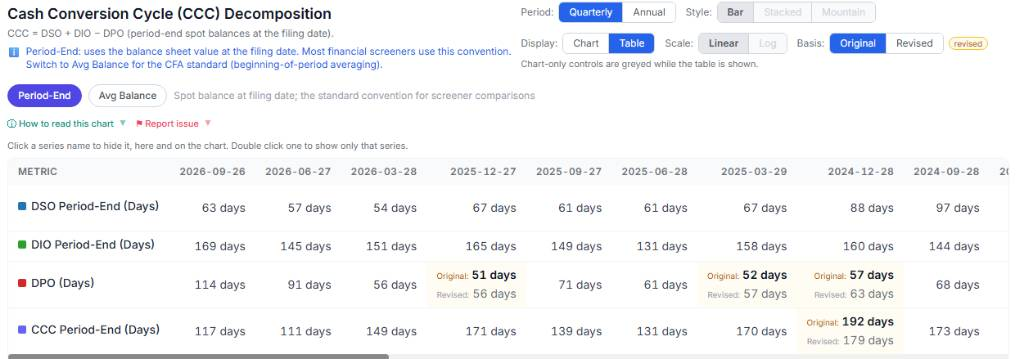
Over the year, receivables grew about as fast as revenue (49% against 45%). Customers now take 63 days to pay, against 61 a year ago and 57 last quarter. That is a small rise, and AMD's 10-Q attributes the increase in receivables to "higher revenue". It is worth watching for one reason: on our measure, receivables growth has just moved ahead of revenue growth for the first time in two years, by about 4 percentage points. DSO cannot see everything, though. It says nothing about return rights or how concentrated the receivables are, and AMD's 10-Q gives no customer breakdown.
Inventory: the real question
Inventory grew faster than sales on both measures. The $3.0B build in one quarter is about five times any other quarter shown, and AMD now holds about 169 days of inventory. AMD's explanation is "the continued ramp of Data Center products in advanced process technology nodes", and it guides fourth-quarter revenue to about $17B, up 27% from the third. If that revenue arrives, the inventory was preparation. If it does not, the inventory is the first place a problem shows up. AMD reported no inventory write-down this quarter.
Payables: what carried the cash flow
AMD paid its suppliers more slowly: payables rose $2.31B in the quarter, and days payable went from 56 to 114 in two quarters. That flatters both cash flow and the cash conversion cycle. Without the rise in payables, the quarter's operating cash flow of $1.20B would have been about $1.1B negative. AMD's 10-Q attributes the increase to "timing of payment obligations and higher inventory purchases", and discloses no supplier finance programme. That is the innocent reading, and it fits the inventory build. It also means the cash comes back out when those bills are paid.
The warrants: a charge that is not a cost, and revenue that will be reduced
AMD's net income of $2.43B includes a $1.1B non-cash loss from revaluing warrants it gave two customers, each over up to 160 million AMD shares. That loss sits below operating profit and is added back in the cash flow statement. Without it, earnings were about $3.5B against $1.2B of operating cash flow, so cash was well behind profit this quarter. AMD also discloses $4.5B of warrant value still to be recorded, as a reduction of revenue, as those customers buy. That is standard accounting for incentives paid to customers, and it is disclosed, but it means part of the coming growth arrives with a deduction attached.
3. Nvidia: what is known, and what is not yet
Nvidia reported its third quarter on 17 November. Unlike its two previous quarters, it did not file its 10-Q the same day. Its CFO commentary says: "We plan to file our 10-Q in the coming weeks." For a company of Nvidia's size the deadline is 40 days after the quarter ended on 25 October, about 4 December. As of 22 November there is no 10-Q, and no notice of late filing.
That matters for how much weight the numbers can bear. The earnings release is unaudited and not reviewed. The 10-Q is not audited either, but it is reviewed by the auditor and carries management's certification of its controls. Until it lands, Nvidia's figures are management's figures.
What the release and supplemental document show:
| Nvidia, quarter to 25 Oct 2026 (unaudited) | Amount |
|---|---|
| Revenue | $115.8B, up 20% on the quarter and 103% on the year |
| Net income | $65.3B |
| Operating cash flow | $48.3B |
| Receivables | $81.0B, against $38.5B in January |
| Days sales outstanding | 64, up from 60 |
| Guidance for the next quarter | revenue of $130.0B, plus or minus 3% |
Nvidia explains the rise in receivables itself: "shipment linearity from our Rubin launch and extended payment terms on large, multi-quarter agreements with certain investment-grade customers." Longer payment terms are legitimate, but they are also the lever that lets revenue be booked earlier than cash arrives, which is why an accountant would look at them first.
Other facts, side by side. We report them; no filing connects them, and neither do we:
- The SEC investigation was reported by Reuters from people briefed on it. Reuters could not determine whether it concerns how Nvidia reports revenue by geography. Nvidia's release does not mention it.
- The geographic presentation. In 2025 Nvidia moved from reporting revenue by customer billing address to customer headquarters, which removed Singapore from its breakdown. That changes where revenue is shown, not how much there is.
- The chief executive resigned on 11 November. Nvidia's 8-K gives no reason. Press reports link the resignation to a personal relationship with a former executive of Megaspeed, a Singapore company, whom US officials reportedly suspect of working for Chinese intelligence. China's foreign ministry rejects it: at its briefing on 9 November its spokesperson said, "The "Chinese spy" allegation is purely unsubstantiated and directed at smearing China." Nvidia has described Megaspeed as an ordinary regional customer and says it is running an independent investigation. The CFO is interim chief executive.
4. The forensic scores: is Nvidia's red M-Score a false alarm?
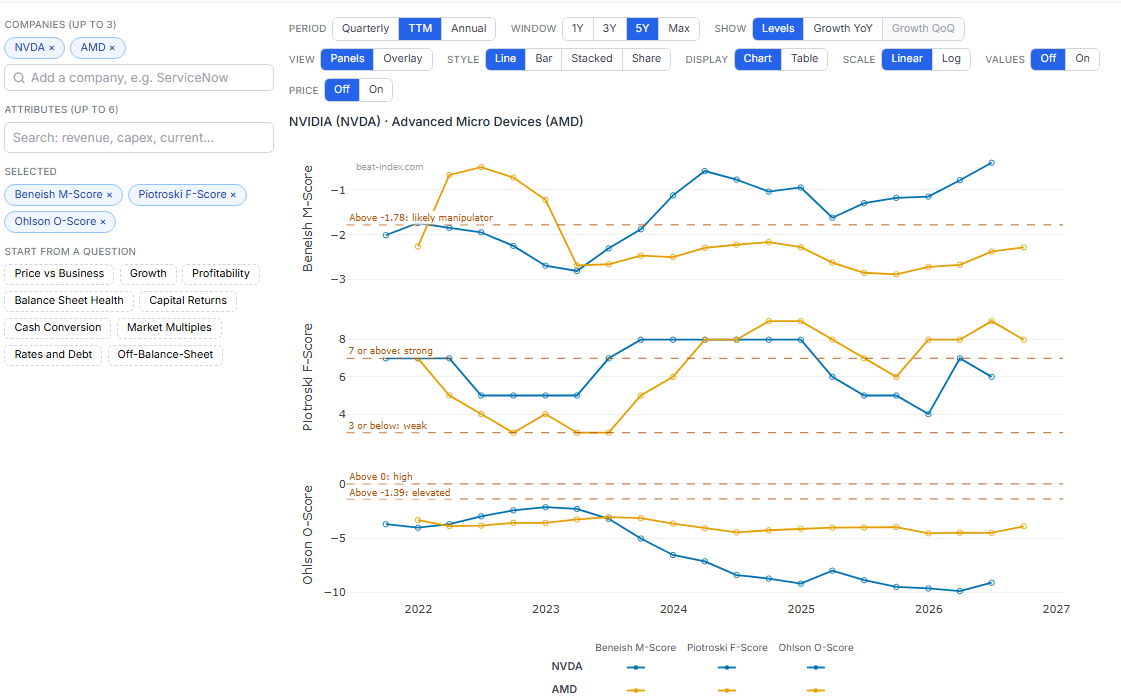
The Beneish M-Score combines eight ratios into one number. Above -1.78, the model flags a company as a likely manipulator. Nvidia is at about -0.39; AMD is at about -2.31.
The usual answer for a company growing as fast as Nvidia is that the score is a false alarm: one of its eight ratios is simply sales growth, so very fast growth pushes the score up on its own. The test is to hold growth at neutral and see whether the flag goes away. We rebuilt both scores, factor by factor, from the filed figures:
| Twelve months to | M-Score | With sales growth held neutral | Reading |
|---|---|---|---|
| Nvidia, July 2024 | -0.78 | -2.52 | Growth explained all of it |
| Nvidia, July 2026 | -0.39 | -1.13 | Growth explains part of it |
| AMD, September 2026 | -2.31 | -2.68 | Clean either way |
In 2024 the growth explanation was complete. Today it is not. Nvidia's score is now driven by four factors:
| Factor in Nvidia's July 2026 score | Adds to the score | What it measures |
|---|---|---|
| Accruals | +0.85 | Net income exceeded operating cash flow by $58.5B over twelve months, 18% of total assets |
| Sales growth | +0.74 | Revenue up 83% |
| Asset quality | +0.25 | Investments and other long-term assets growing |
| Receivables against sales | +0.22 | Receivables growing faster than revenue |
The largest factor is accruals, the gap between profit and cash. Part of it is benign: Nvidia booked $16.4B and $7.8B of non-operating income in its last two filed quarters, largely gains on its investments, which count as profit without producing cash. On our own rough estimate, removing those gains moves the score to about -0.7, still above the line. The rest of the gap is working capital: receivables and inventory growing faster than sales, which Nvidia attributes to longer payment terms. The M-Score cannot tell longer payment terms from manipulation. It can only say that the gap between profit and cash has widened. Nvidia's unaudited third quarter shows the same pattern, so the score is likely to stay high when the 10-Q is filed.
The other two scores are simpler. Nvidia's Piotroski F-Score has slipped from 8 to 6, mostly because operating cash flow no longer exceeds net income, which is the same signal again. AMD's is 8, which is strong. The Ohlson O-Score measures the risk of financial distress, not the honesty of the accounts, and both companies are far from distress on it.
5. The balance of probabilities
Revenue that does not exist: very unlikely at either company. Nvidia's operating cash flow over the last twelve filed months was $134B, and $48B in the latest quarter. Revenue that does not exist does not turn into cash on that scale. Its largest customers are listed companies whose own audited capital spending is consistent with what Nvidia reports selling, and its gross margin was 74.8% in the latest quarter, where discounting to push product would usually show.
A narrower accounting issue at Nvidia: possible, and more likely than a month ago. A reported SEC investigation, a chief executive's resignation without a stated reason, a 10-Q that did not arrive with the results, and an accruals signal that growth alone no longer explains, together raise the odds above the normal background rate. If there is an issue, the filings point to timing rather than fabrication: when revenue on multi-quarter agreements is booked, and how Nvidia accounts for its investments in companies that are also customers. None of this is confirmed, and the resignation may have nothing to do with the accounts.
AMD: low. Cash lagged profit this quarter, but AMD's own filing explains why, and the short report's allegation is about export compliance, not the accounts.
6. What could prove us wrong
AMD
- An inventory write-down, or days of inventory still climbing next quarter without the revenue to match.
- Fourth-quarter revenue well short of the $17B guidance.
- Operating cash flow negative once the timing of supplier payments is stripped out.
- Receivables continuing to grow faster than revenue.
- A Commerce Department finding, or AMD disclosing an export-control proceeding.
Nvidia: what the 10-Q has to settle
- Any revision or restatement of earlier periods.
- Its controls section: any material weakness, or a change in internal control.
- How revenue is recognised on multi-quarter agreements with extended terms.
- Its investments in customers, and whether any consideration paid to them reduces revenue.
- Whether its legal proceedings note discloses the SEC investigation, the shareholder lawsuits and the independent investigation.
- Whether it is filed by about 4 December, or a notice of late filing appears instead.
7. Against the risk-free rate: $1,000 in Treasuries or in AMD?
Any share has to beat what you could earn with almost no risk: a US Treasury held to maturity. The latest published yields (Federal Reserve, FRED series DGS3, DGS5 and DGS10, 19 November 2026) are 4.81% for 3 years, 4.86% for 5 years and 5.04% for 10 years.
| $1,000 placed in | Yield a year | Held for | Worth at the end |
|---|---|---|---|
| 3-year Treasury | 4.81% | 3 years | about $1,151 |
| 5-year Treasury | 4.86% | 5 years | about $1,268 |
| 10-year Treasury | 5.04% | 10 years | about $1,635 |
These assume the interest is reinvested at the same yield and the Treasury is held to the end.
At $424.39, AMD is valued at about 99 times its free cash flow of the last twelve months, $7.06B. To match the 3-year Treasury, AMD needs to be worth about $489 a share in three years. Here is what $1,000 in AMD becomes on three illustrations of our own. They are deliberately ultra-conservative: each assumes the market pays far less for AMD's cash flow in three years than it does today. Each grows free cash flow for three years, values it at the multiple shown, and adds today's $8.7B of net cash and the cash earned along the way:
| If AMD's free cash flow grows | Valued at | Worth in about 3 years | $1,000 becomes | A year | Against the 3-year Treasury ($1,151) |
|---|---|---|---|---|---|
| 30% a year, about its record | 30x | about $307 | about $723 | (10.2%) | ($428) |
| 50% a year | 35x | about $537 | about $1,265 | 8.2% | $114 |
| 70% a year, warrants fully vested | 35x | about $651 | about $1,534 | 15.3% | $383 |
The fast-growth case assumes the two customers buy enough for their warrants to vest in full, adding up to 320 million shares, so its value is spread over about 1.98 billion shares rather than 1.66 billion. That is the cost of the growth those warrants buy.
The table is the sober part of this post. AMD's accounts do not worry us. Its price still asks a lot: even after this week's fall, free cash flow has to grow about 50% a year for three years to beat a Treasury by about 3 percentage points a year, and repeating its record growth would lose money. The case for owning AMD at this price is the case that its AI business grows far faster than it ever has.
Conclusion: where we stand
The short report on AMD is an export-control story, and the financial statements cannot settle it either way. What they can settle, they do: AMD's receivables track its sales, its inventory build has a stated purpose that the next quarter will test, and its weak cash flow this quarter is explained in its own filing. On the balance of probabilities, we see no sign of accounting manipulation at AMD, and the short report does not change our view of the business.
Nvidia is different only in that its evidence is incomplete. Its numbers are strong and its cash is real, but its accruals have widened, its receivables are rising on longer payment terms, and its 10-Q is not yet filed. We see no evidence of manipulation in what has been published, and we will read the 10-Q against the checklist above when it arrives.
We are keeping both positions: shares in AMD and Nvidia, and the company's LEAPS on each. We added nothing to either this week. The LEAPS are there because our risk limits allowed no more equity when we bought them; options magnify both gains and losses and can expire worthless. Any of our accounts may still buy or sell either stock, in shares or options, within those limits.
On AMD, we are not adding at this price: section 7 shows how much growth $424 already assumes. The fourth quarter, and whether that $3B of inventory becomes revenue, is the next real test.
On Nvidia, the next real test is the 10-Q. If it lands on time, matches the earnings release and answers the checklist above, the case below, that Nvidia is undervalued, stands. A late filing, a restatement or a new risk factor would make us look again.
Why we think Nvidia is undervalued and AMD overvalued
| Last four quarters | Nvidia | AMD |
|---|---|---|
| Share price | $125 | $424.39 |
| Market value | about $3.0 trillion | about $0.70 trillion |
| Free cash flow | $148.7B | $7.06B |
| Price to free cash flow | about 20x | about 99x |
| P/E | about 13x | about 91x |
Nvidia generates about 21 times AMD's free cash flow, yet the market values it at only about four times as much. We think AMD's premium reflects its position as the only proven alternative to Nvidia in AI accelerators. That position is real and valuable, but at about 99 times free cash flow the price already pays for it, as section 7 shows. Nvidia's discount reflects this week's uncertainty: the reported probe, the leadership change and the late 10-Q. If the 10-Q answers the checklist above cleanly, we think that discount is too wide. That is why we see Nvidia as undervalued and AMD as overvalued.
Two cautions. Nvidia's earnings include large gains on its investments, so price to free cash flow is the fairer comparison than P/E. And Nvidia's latest quarter is unaudited, so its figures could still change when the 10-Q is filed.
Our two-year view
We cannot say where either share price goes tomorrow or next week. That is out of anyone's control, and this week showed how fast sentiment can move. Over about two years, if no new material evidence of accounting problems emerges and there is no recession, we think AMD should be back to about $500 and Nvidia to about $220. Like section 7, this is an ultra-conservative view, as the next table shows.
From the prices used here, those are very different returns:
| Two-year view | Price used | Our view | $1,000 becomes | A year |
|---|---|---|---|---|
| AMD | $424.39 | about $500 | about $1,178 | about 8.5% |
| Nvidia | $125 | about $220 | about $1,760 | about 33% |
| Treasury at the 3-year yield of 4.81%, held two years | about $1,099 | 4.81% |
Put plainly: on our own view, AMD at $500 would beat a Treasury over two years, about 8.5% a year against 4.81%, but the larger recovery is at Nvidia, which is also where the open questions in this post sit. Both views fail if the 10-Q, or anything else, brings material new evidence of accounting problems, or if a recession cuts AI spending.
What the market has actually paid
Our views above assume the market will pay less for each company's earnings than it does now. Here is what it has paid over the last two years. We took each stock's lowest and highest closing price in 2025 and 2026 (closing prices as shown on Google Finance) and divided each by the trailing twelve-month earnings per share the company had filed by that date, from Beat Index. That gives the lowest and highest price-to-earnings ratio (P/E) the market paid; the three rungs between are spaced evenly.
We strip out one-time items first, so they do not skew the multiple. Both companies hold stakes in other companies, and when those stakes are revalued the gain or loss runs through profit, though nothing was sold and no chip was made. Nvidia booked $15.9B of such gains in one quarter this year, enough to make its P/E look far cheaper than its business is. AMD's earnings carry the opposite distortion: a $1.1B loss in its September quarter from revaluing the warrants it gave two customers. We remove both, net of tax where tax applies, and work from earnings from the business itself. On that basis Nvidia's trailing earnings per share are $8.24 rather than $9.30, and AMD's $4.81 rather than $4.61.
We then apply each P/E to those earnings, growing at our own assumptions: 50% a year for AMD, as in section 7, and a conservative 20% a year for Nvidia, whose earnings per share on the same basis more than doubled over the past year, from $3.89 to $8.24.
Each cell shows what $1,000 put in today becomes, with the share price that implies in brackets. AMD starts from $424.39 and Nvidia from $125.
| P/E paid | AMD P/E | AMD, 1 year | AMD, 2 years | Nvidia P/E | Nvidia, 1 year | Nvidia, 2 years |
|---|---|---|---|---|---|---|
| Our ultra-conservative view | 46x | $1,085 ($461) | $1,178 ($500) | 19x | $1,327 ($166) | $1,760 ($220) |
| Lowest paid | 77x | $1,316 ($558) | $1,974 ($838) | 15x | $1,200 ($150) | $1,440 ($180) |
| Lower middle | 105x | $1,783 ($756) | $2,674 ($1,135) | 27x | $2,100 ($263) | $2,520 ($315) |
| Middle | 132x | $2,249 ($955) | $3,374 ($1,432) | 38x | $3,001 ($375) | $3,601 ($450) |
| Upper middle | 160x | $2,716 ($1,153) | $4,074 ($1,729) | 49x | $3,901 ($488) | $4,681 ($585) |
| Highest paid | 187x | $3,183 ($1,351) | $4,774 ($2,026) | 61x | $4,802 ($600) | $5,762 ($720) |
| 3-year Treasury at 4.81% | $1,048 | $1,099 | $1,048 | $1,099 |
AMD's lowest P/E was paid in March 2026 and its highest in October 2026; Nvidia's lowest is today's, 20 November 2026, and its highest was in October 2025. The P/E on our own views is what each price implies on the earnings above in two years; the 1-year figure is the halfway point on the same path.
For AMD, the lowest multiple the market paid in two years, 77x, would turn $1,000 into about $1,974 in two years, a share price of about $838, 68% above our $500. Our view assumes the multiple falls to about 46x, well below anything paid in that time. For Nvidia it runs the other way: today's 15x is already the lowest of the two years, and held there it turns $1,000 into about $1,440, a share price of about $180, 18% below our $220. Our Nvidia view needs the multiple to recover only to about 19x, against the 33x it fetched at its lowest in 2025.
This table assumes the market keeps paying multiples like these while the growth arrives. Multiples usually shrink as fast growth turns into ordinary growth, which is why our own views sit lower. AMD's 2024 is left out: its earnings that year were too small for a P/E to mean much.
Holding our own multiples fixed, 46x for AMD and 19x for Nvidia, and changing only how fast earnings grow, $1,000 after two years becomes:
| $1,000 in, after 2 years | AMD at 46x | Nvidia at 19x |
|---|---|---|
| Worst case | $885 (earnings up 30% a year, share $376) | $1,479 (up 10% a year, share $185) |
| Middle case | $1,178 (up 50% a year, share $500) | $1,760 (up 20% a year, share $220) |
| Best case | $1,513 (up 70% a year, share $642) | $2,066 (up 30% a year, share $258) |
| 3-year Treasury at 4.81% | $1,099 | $1,099 |
At our own multiple, Nvidia beats the Treasury even if its earnings grow only 10% a year, because 19x is close to the 15x it trades at today. AMD loses money in the worst case and beats the Treasury only if earnings grow about 50% a year or more, the same conclusion as section 7. We show two years only: these multiples come from our two-year views, and applying them to next year's earnings would mark the shares down before the growth that justifies them arrives.
This is our opinion, based on the companies' filings and what we can reasonably foresee today. It is not a recommendation to buy or sell, and it may prove wrong.
Every figure above comes from the two companies' own filings. See them for yourself: AMD on Beat Index and Nvidia on Beat Index.
How we worked
AMD's figures come from its 10-Q for the quarter to 26 September 2026, its earnings release of 3 November and its 2025 10-K. Nvidia's come from its unaudited earnings release, CFO commentary and supplemental document of 17 November and its 8-K of 12 November, because its 10-Q has not been filed. All were processed by the Beat Index pipeline or read directly from SEC EDGAR. Working-capital figures use the revised basis and period-end balances. We rebuilt the Beneish M-Score factor by factor from the filed figures; the adjustment for Nvidia's investment gains, the three AMD illustrations and the balance-of-probabilities assessment are our own estimates on the assumptions stated. The reporting on the SEC investigation, the short report and Nvidia's leadership change is attributed to the outlets that published it. The AMD share price is the close on 20 November 2026; Nvidia's price is $125, as of the same day.
Sources
- Hunterbrook, "AMD Has Its Own China Problem", 19 November 2026
- Hunterbrook, "The Bank of AMD", 19 November 2026
- AMD 10-Q for the quarter to 26 September 2026
- AMD 10-Q for the quarter to 27 June 2026
- AMD 2025 10-K
- AMD, Regulatory Trade Compliance
- Nvidia 8-K, 12 November 2026
- Nvidia 8-K, 23 November 2026: Jensen Huang reinstated
- Nvidia CFO commentary, 17 November 2026
- Reuters, "Nvidia's accounting is a focus of US SEC investigation, sources say", 20 November 2026, via Investing.com
- China's Ministry of Foreign Affairs, regular press conference, 9 November 2026
About the author
Krishna Prasad
Krishna Prasad is the founder of Beat Index, a former banker and a private investor. He is also an algorithmic trader who runs his own bespoke algorithms and licenses them to proprietary trading firms. He is not a regulated financial adviser. The financial figures in this post come from AMD's and Nvidia's own filings with the US SEC.
Disclaimer. This is the author's personal opinion, for information only. It is not investment or financial advice, and not a recommendation to buy or sell any security. Valuations are estimates that depend on assumptions which may prove wrong, and you can lose money.
The author, his family, his tax-advantaged accounts and his wholly owned company hold AMD and NVDA and may buy or sell them at any time, including shortly after publication.
Originally published 22 November 2026 at share prices of AMD $424.39 and NVDA $125 (close of 20 November 2026).
Financial data: the company's own filings with the US SEC (EDGAR).